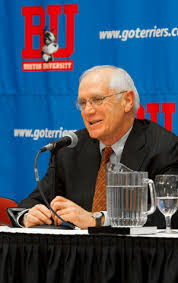
In the fall of
1970, Jack Parker became a volunteer assistant coach
under legendary BU Head Coach Jack Kelley. Parker,
who later would lead the Terriers for 40 seasons, had been a BU captain just three
years earlier. With Kelley’s passing two months ago and Assistant Coach Bob Crocker having died two years ago, Parker is one
of two remaining members of the ’70-’71 coaching staff. The other one is goalie
coach Andy Fila. Parker recently shared his
thoughts about BU’s first NCAA championship team. THFB—The 1969-70 team, after a slow start,
had won 16 of its final 19 before a tough last-second loss to Clarkson in the
ECAC semifinal. Looking ahead that
Spring, what did the coaches assess the prospects to be for the next season and
the chances to challenge for a national title?
JP—It was disappointing
to lose [in the ’70 ECACs]. We had a very solid team that really came on in the
second half of the year. A great sophomore class and a big senior group with
some star players. Even before that season had ended, we knew the next season
was going to be something special, because Jack Kelley (photo) and Bob Crocker had
recruited two fabulous classes back-to-back. That’s how you usually win big,
when you have two really successful classes back to back. [Ed.: The ’68-’69 freshman
team went undefeated; the ’69-’70 frosh only lost twice]. One thing we didn’t
have in ’69-’70 was a real solid defense. We had some pretty good players, but
nothing like what we added the next year in Bob Brown, Ric
Jordan and Mike LaGarde. Brown and Jordan
were great offensive players and LaGarde was a terrific defensive defenseman.
We knew the next season was going to be a pretty good year, but we weren’t
thinking so much about winning a national championship; Jack had such a bad
track record in the ECAC semis that he was just hoping to win an ECAC
championship. [BU had lost in the ECAC semifinals five of the previous six
seasons].
THFB—Do you
see a similarity between the ’70 loss to Clarkson and the ’08 season-ending
loss to Vermont as motivation to address unfinished business? Did Coach Kelley
use that loss as a motivator the next season?
JP—I don’t
think so. The big motivator was that we’d lost again in the ECAC finals again.
We needed to get to the [ECAC] championship game and that would get you to the
national tournament. Winning that Friday night game was very important to them
and to the history of the program.
THFB—Five of
players from that ’69-’70 freshman team—Ron Anderson, Steve Dolloff, Bobby
Brown, Ric Jordan and Mike LaGarde— would be inserted into important roles on
the 70-71 squad. Was their impact—especially Ric and Bobby combining for 110
points on defense—at all surprising?
JP—I had seen
them play as freshmen a number of times and knew they would really add
something to the team. What made the ‘70-‘71 team so successful that year—and
get labeled as the best BU team ever—was they were so good on the power play.
And the reason for that was because they had Jordan and Brown (photo) on the points. Jordan
had 12 goals and Brown had 17, which was unheard of for defensemen at that
time. Just gaudy stats for defensemen. And the power play was successful at a 40
or 41% rate, the highest in BU history. What really set this BU team apart—and
you can look this up— is that [they] got more power-play goals than the opposition
got total goals. I don’t know if that has ever happened at any other level. [We
did look it up and Jack was right; 66 power play goals vs.60 total allowed.]
THFB—Goalies
and classmates Dan Brady and Tim Regan put together remarkable numbers in 1970-71,
including a combined 1.91 GAA. Dan earned All-American honors and Tim’s GAA and save
percentage are still program bests. Was that kind of success expected based on
the prior season.

JP—Yes, it was
and it was based on their freshman year, too, when they played every other game
for the undefeated freshman team. As sophomores, they both had good years, but
not All-American seasons. Jack had a theory that you had to establish a #1
goalie, so he decided that Tim Regan (photo) was going to be the #1 goalie when they
were sophomores. To start 1970-71, Tim still was the #1 goalie until we lost up
at Cornell [after a 12-0-1 start]. Jack decided to go with Danny who
played the rest of the way. I always had a different theory. If I had two
really good goalies, I’d play them both. When I had Brian
Durocher and Jim Craig, I’d play them
every other game until someone separated themself. It put more pressure on them
to perform.
THFB—What was the impact of the new on-campus
facility, Walter Brown Arena, not being completed in time for the 1970-71
season as had been planned?
JP—It made us vagabonds.
We would dress in the West Campus basement next to the new rink, then we’d get
into vans to travel to [Harvard’s] Watson Rink, maybe 10 minutes across
the river. The problem was we had to practice after the Harvard freshmen and
varsity teams were done. We’d start practice around 6:00 and go to 7:30. That
was inconvenient to say the least. The other difficult thing was that Watson
was the largest ice surface in college hockey in the East, except for Army.
Boston Arena, where we played our home games, was the smallest rink. We still
had the advantage playing in the Arena, even though we never practiced there.
It was egg-shaped, there were no corners. It was a tiny bandbox of a rink. Not
having Walter Brown ready helped us because it made us more determined,
hungrier.
THFB—In the
Fall of 1970, BU charged hard out of the gate winning 13 of its first 14 with
one tie—many by lopsided scores. Did that level of success change the coaching
staff’s expectations or was that what they’d anticipated?
JP—No it didn’t
change Jack’s or Bob’s opinion of the team. The league wasn’t that well balanced
back then, so you could win some games 10-2. We knew we had to keep getting
better to get by the hurdles we’d face later in the season.
THFB—That
streak ended with a loss to Cornell in Ithaca. How did the team respond and
what was the impact on Coach Kelley of not getting that elusive win against the
Big Red?
JP—Obviously there was a great rivalry for
Jack with [Cornell Coach] Ned Harkness, going back to when Jack was at
Colby and Harkness was at RPI. It burned Jack that he hadn’t beaten Ned. I
recall him being so upset after the game and that’s when he decided to go with
Danny Brady in goal. Timmy didn’t play that badly but Jack wanted to shake up
the team. Brady got his chance to play and took over the rest of that year.
THFB—BU went
back on a roll, reeling off a dozen straight victories. That included a Beanpot
title game win over Harvard, but the Crimson upset BU in the ECAC
semifinal—only the second defeat of the season. How did the team and coaching
staff respond to the seeming likelihood that there would again be no trip to
the NCAAs?
JP—It was
almost shocking after we’d beaten Harvard in the Beanpot. We lost because they
shut down our power play, which no one could ever do…because they never took a
penalty. Once again, we were on the outside looking in. That was one of the
most down moments I’d ever seen for Jack Kelley. If he was ever going to win
the ECACs, this was the year. Fortunately, we were playing Cornell in the
consolation with a chance to redeem ourselves. If there was no consolation game,
we would not have gone to the NCAA tournament.
THFB—Did the
team and coaching staff go into the consolation game believing there was still
a chance to earn an NCAA berth? After the win, how long was the wait for the
ECAC Committee’s decision?
JP—Yes, we did
think there was a chance. I don’t know if this is true or not, but [Colgate
Coach] Ron Ryan was on the selection committee and let Jack know “you might
not be out of it; they want to look at the consolation game. No guarantees.” It
wasn’t a typical consolation game because we were playing Cornell. The fact
that we won that game [6-5 with Stirling scoring the game-winner], led the
tournament committee to send us [to the nationals]. Jack called me the
next night and said “we’re practicing tomorrow. Harvard had won the ECACs and,
of course, they were going, too, so once again, we’re practicing after Harvard.
THFB—In the NCAA semifinal, BU was matched
with an older and much bigger team in Denver. What were the keys to BU’s 4-2
victory?
JP—We had the
best team. They might’ve been older and bigger, but we had great goaltending,
great defensemen and a bunch of really solid forwards. When you have Steve Stirling and John Danby centering
your first two lines and soon-to-be All-American Steve
Dolloff centering your third line, plus Jordan and Brown on defense and
Danny in the net, there was nobody matching us. And our team was mostly juniors
and sophomores. Toot Cahoon had a hat trick for
us.
THFB—In the championship game, BU faced a
Minnesota team it had shut out, 6-0, earlier in the season. On the brink of the
program’s first title, how did Coach Kelley make sure the team wasn’t too
revved up for the game?
JP—I think it
was the opposite. We wanted to make sure they didn’t take Minnesota [which
had beaten Harvard] too lightly. They didn’t have a spectacular record but
got hot late in the season and won the WCHA championship. So, Jack was building
them up saying “these guys are really good and you’d better be ready for them.”
[BU would take an early 2-0 lead and win its first-ever title, 4-2, with two
goals from Stirling. Extended
Video Highlights]
THFB—In evaluating the season, how do you
compare this team to other BU championship and NCAA finalist squads?
JP— I think
this was the best BU team of all time. One, because they were 28-2-0. Two,
because they were so spectacular on the power play. And we were very stingy at
the defensive end with two great goalies. I could say the ’78 team was a great BU
team and the ’95 team was one of the best BU teams of all time, no question.
The ’76 team and the ’91 team were probably the best BU teams that didn’t win the
national tournament. I’d like to say one of my teams was the best, but the ‘71 team
was unbelievable because they dominated so many teams score-wise, mostly
because they were so spectacular on the power play. In my mind, that was the
best BU team in history.